
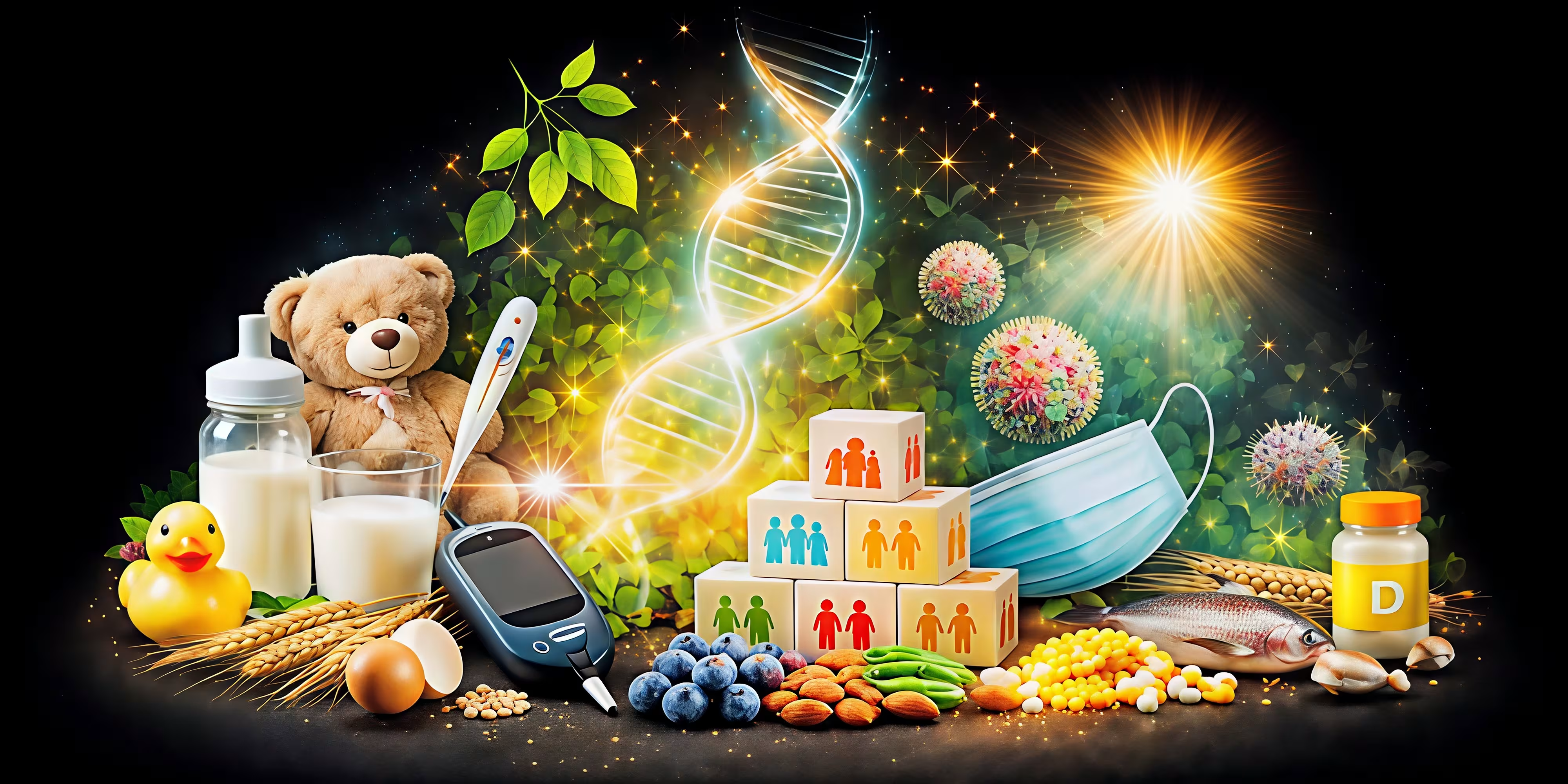
What are the chances my child will develop type 1 diabetes?
If you have type 1 diabetes, the risk for your child depends on several factors. If you are a mother with type 1 diabetes, your child has approximately 3% chance of developing T1D by age 20 [1]. If you are a father, the risk is double, approximately 6% [1]. These figures are higher than the risk in the general population (0.4%), but probably much lower than you expected.
The risk increases if you were diagnosed at a very young age (under 10 years) or if both parents have type 1 diabetes (risk of 10-25%) [2]. Important to remember is that over 85% of children with type 1 diabetes have no parent with this disease [3], so genetics is a minor part of the equation.
If I have T1DM, will my siblings also have it?
Your siblings have approximately 8% risk of developing type 1 diabetes by adulthood, compared to 0.4% in the general population, that is 20 times higher [4]. If you are identical twins, your twin brother or sister has 40-65% chances of developing the disease (increasing with age) [4]. This shows us that genetics is not everything. Environmental factors actually play a crucial role.
The risk is higher in the first years after your diagnosis and gradually decreases over time. Your siblings can be tested for type 1 diabetes-specific autoantibodies to more accurately assess the risk [5]. A positive test doesn't necessarily mean certainty they will develop the disease, but only a very increased risk that requires careful monitoring.
Are there genetic tests for T1DM prediction?
Yes, there are genetic tests that can evaluate predisposition for type 1 diabetes, especially testing for HLA genes (DR3, DR4, DQ2, DQ8) [6]. Approximately 90% of people with type 1 diabetes have one or both HLA-DR3 or DR4 risk variants [6]. However, these genes are also present in nearly half of the general population who never develop type 1 diabetes.
Genetic tests alone are not sufficient for prediction. They only identify susceptibility. More useful are tests for autoantibodies (GAD, IA-2, IAA, ZnT8), which can predict diabetes development with fairly good accuracy [5].
Can viral infections trigger T1DM?
Viral infections are considered one of the main triggers of type 1 diabetes in genetically predisposed individuals [7]. Viruses such as enteroviruses (especially Coxsackie B), rotavirus, cytomegalovirus or mumps virus have been associated with the clinical onset of diabetes (stage 3 of the disease) [7]. These can directly attack beta cells or can trigger an abnormal immune response.
This doesn't mean that any cold or flu will cause you type 1 diabetes. Most people go through the same infections without problems. Only in those with genetic predisposition and under certain conditions, viral infection can be the straw that breaks the camel's back and triggers the autoimmune process of beta cell destruction or, more frequently, already the transition to hyperglycemia [8].
Do environmental factors influence the occurrence of T1DM?
Environmental factors play a crucial role in triggering type 1 diabetes. Proof is the disease incidence increasing by 3% annually, consistently over recent decades [9]. This increase is too rapid to be due to genetic changes. Early exposure to cow's milk proteins, early introduction of cereals, vitamin D deficiency and changes in intestinal flora are intensely studied factors, not necessarily confirmed [2].
The hygiene hypothesis suggests that the overly clean environment in developed countries doesn't train the immune system enough, increasing the risk of autoimmune diseases [9]. Other investigated factors include pollution, major psychological stress, traumas and even rapid weight gain in childhood [2]. None of these factors alone directly causes type 1 diabetes. They can contribute little by little to triggering it in susceptible individuals.
Does breastfeeding protect against T1DM?
Studies suggest that exclusive breastfeeding for at least 3 months can reduce the risk of type 1 diabetes by approximately 15-25% [10]. Breast milk contains antibodies and growth factors that help mature the baby's immune system and can protect against infections that may contribute to triggering autoimmunity [10].
On the other hand, early introduction of cow's milk (before 3 months) has been associated with increased risk of type 1 diabetes [11]. Proteins from cow's milk, especially beta-casein A1, can trigger an autoimmune response in predisposed individuals. However, the protective effect of breastfeeding is not absolute. Many breastfed children develop type 1 diabetes, and many formula-fed do not subsequently develop the disease [10].
Does vitamin D have a role in T1DM prevention?
Vitamin D has an important role in regulating the immune system, and its deficiency has been associated with increased risk of type 1 diabetes [12]. Nordic countries, with reduced sun exposure and vitamin D deficiency, have the highest rates of type 1 diabetes in the world [12].
If you have type 1 diabetes or increased family risk, maintaining optimal vitamin D levels (over 30 ng/ml) is recommended, although it doesn't guarantee prevention [13]. Moderate sun exposure and diet rich in natural sources of vitamin D are simple and safe strategies that can help, having other health benefits as well.
Can stress trigger T1DM?
Severe psychological stress can be the final factor that triggers type 1 diabetes in people who already have an ongoing autoimmune process [14]. Traumatic events such as the death of a parent, parental divorce or serious accidents have been associated with type 1 diabetes onset in the following months [14]. Chronic stress alters immune system functioning and can accelerate beta cell destruction.
This doesn't mean that normal life stress causes type 1 diabetes. We're talking here about major, traumatic events. Also, stress alone cannot cause type 1 diabetes if there's no genetic predisposition and autoimmune process already started [15]. Stress management is important for overall health, but cannot completely prevent diabetes occurrence in those predisposed.
Are there ethnic differences in T1DM risk?
Yes, there are significant ethnic differences in type 1 diabetes incidence [16]. Caucasian populations, especially those from northern Europe, have the highest rates. Finland has a record incidence of 60 cases per 100,000 per year [17]. In contrast, Asian, African and Native American populations have rates 10 times lower [16].
These differences reflect both genetic variations (frequency of HLA risk genes) and environmental factors [18]. Interestingly, when populations migrate, the incidence tends to approach that of the host country within a few generations [18]. This underscores the importance of environmental factors (from the host country).
References
- Characteristics of familial type 1 diabetes: effects of the relationship to the affected family member on phenotype and genotype at diagnosis. Diabetologia. 2019;62(11):2025-2039. PubMed
- Environmental risk factors for type 1 diabetes. Lancet. 2016;387(10035):2340-2348. PubMed
- From Prediction to Prevention: The Intricacies of Islet Autoantibodies in Type 1 Diabetes. Curr Diab Rep. 2025;25(1):38. PubMed
- Identical and Nonidentical Twins: Risk and Factors Involved in Development of Islet Autoimmunity and Type 1 Diabetes. Diabetes Care. 2019;42(2):192-199. PubMed
- Understanding Islet Autoantibodies in Prediction of Type 1 Diabetes. J Endocr Soc. 2024;8(1):bvad160. PubMed
- Genetic Discovery and Risk Prediction for Type 1 Diabetes in Individuals Without High-Risk HLA-DR3/DR4 Haplotypes. Diabetes Care. 2025;48(2):202-211. PubMed
- Coxsackievirus and Type 1 Diabetes: Diabetogenic Mechanisms and Implications for Prevention. Endocr Rev. 2023;44(4):737-751. PubMed
- Persistent coxsackievirus B infection and pathogenesis of type 1 diabetes mellitus. Nat Rev Endocrinol. 2022;18(8):503-516. PubMed
- Changes in the Global Epidemiology of Type 1 Diabetes in an Evolving Landscape of Environmental Factors: Causes, Challenges, and Opportunities. Medicina (Kaunas). 2023;59(4):668. PubMed
- Current evidence on the associations of breastfeeding, infant formula, and cow's milk introduction with type 1 diabetes mellitus: a systematic review. Nutr Rev. 2012;70(9):509-519. PubMed
- Early feeding and risk of type 1 diabetes: experiences from the Trial to Reduce Insulin-dependent diabetes mellitus in the Genetically at Risk (TRIGR). Am J Clin Nutr. 2011;94(6 Suppl):1814S-1820S. PubMed
- Vitamin D and increasing incidence of type 1 diabetes-evidence for an association? Diabetes Obes Metab. 2010;12(9):737-743. PubMed
- Vitamin D and Beta Cells in Type 1 Diabetes: A Systematic Review. Int J Mol Sci. 2022;23(22):14434. PubMed
- Psychological stress and the risk of diabetes-related autoimmunity: a review article. Neuroimmunomodulation. 2006;13(5-6):301-308. PubMed
- Family psychological stress early in life and development of type 1 diabetes: the ABIS prospective study. Diabetes Res Clin Pract. 2013;100(2):257-264. PubMed
- The Changing Epidemiology of Type 1 Diabetes: A Global Perspective. Diabetes Obes Metab. 2025;27(Suppl 6):3-14. PubMed
- Incidence of type 1 diabetes in Finland. JAMA. 2013;310(4):427-428. PubMed
- Ethnic differences in incidence of type 1 diabetes among second-generation immigrants and adoptees from abroad. J Clin Endocrinol Metab. 2010;95(2):847-850. PubMed